Date: 11/3/2025
Passwords
Common Techniques Hackers Use to Crack Passwords
Learn how hackers crack passwords using methods like brute-force attacks, dictionary attacks, and rainbow tables. Discover how to better protect your accounts.
TL;DR
Hackers use techniques such as dictionary attacks, brute-force attacks, and rainbow tables to crack passwords. Strong passwords and Multi-Factor Authentication (MFA) help secure your accounts.
How do hackers obtain password hashes?
When you enter a password, it is not stored in plain text but as a hash. Hackers can access these hashes in various ways:
- Data breaches: During a security breach, hackers can steal databases containing user information, including password hashes.
- Insecure systems: Poorly secured servers can be hacked, giving attackers access to stored hashes.
Steps hackers take to crack password hashes
- Dictionary attacks: Hackers compare stolen hashes with lists of commonly used passwords.
- Brute-force attacks: Systematically trying all possible combinations until a match is found.
- Rainbow table attacks: Precomputed tables of passwords and hashes used to quickly find matches.
How does the password hash cracking process work?
- Collecting hashes: Hackers obtain password hashes through data breaches or by compromising systems.
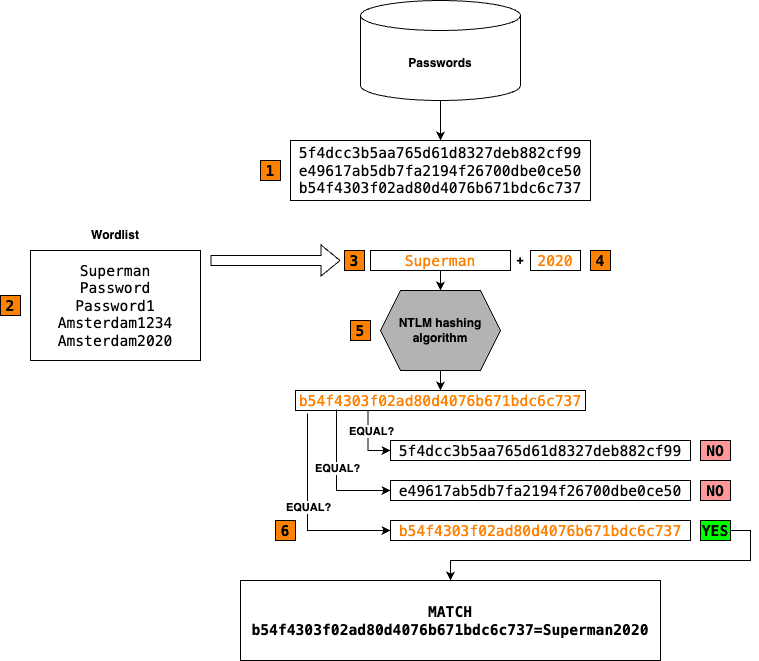
- Testing hashes against a wordlist: For example, the NTLM hash 5f4dcc3b5aa765d61d8327deb882cf99 corresponds to the password 'password'. Hackers compare stolen hashes against dictionary lists.
- Testing words step by step: The attack starts with the first word in the list, for example, 'London'. This is hashed and compared with the stolen hash.
- Generating variations: If no match is found, hackers test variations like 'London2025!' by adding special characters, numbers, or other modifications.
- Running it through the algorithm ('secret sauce'): Each modified word is hashed again and compared to the stolen hash.
- Match found? Password cracked! If a hashed input matches the stolen hash, hackers have discovered the original password.
Below is a schematic representation of the process:
Protective measures
- Use strong, unique passwords: Combine letters, numbers, and symbols, and avoid predictable patterns.
- Use passphrases: Phrases like ‘MyDogBuddy2025LovesRunningInThePark?!’ are easy to remember but hard to guess.
- Implement Multi-Factor Authentication (MFA): Additional security layers make unauthorized access more difficult.
- Use a password manager: These tools generate and store complex passwords for you.
- Be cautious of phishing attempts: Do not click on suspicious links and never share your password.
Conclusion
Understanding the techniques hackers use to crack passwords is crucial for implementing effective security measures. By proactively using strong passwords, applying additional authentication methods, and remaining vigilant against phishing attempts, you can significantly reduce the risk of unauthorized access to your data.
Want to make sure your passwords are secure?
Get a security audit and identify vulnerabilities in your security strategy.
Request a security assessment